

Family Therapy Brisbane: Practical Support for Stronger Family Relationships

Family therapy in Brisbane gives your family a structured, supportive space to understand what is going wrong, communicate more clearly and work towards practical change together.

Glenn Munt has worked in private practice in Brisbane since 1988.

Accredited Mental Health Social Worker, Family Therapist and Medicare provider.

Former President of the Queensland Association of Family Therapy.

Flexible weekday hours with Saturday appointments available.

When Family Life Starts Feeling Stuck

Most families do not come to therapy because one person is the problem. They come because the same arguments, misunderstandings or patterns keep repeating and nobody is quite sure how to change them.

You might be dealing with tension between a parent and teenager, conflict after a separation, a major change in the family, grief, sibling issues, or simply the feeling that people in the same home have stopped hearing each other.

Family therapy looks at what is happening between people, not just what is happening inside one person. The aim is to help each family member understand the pattern, communicate more clearly and find practical ways to respond differently.

At Thinking Families, the work is structured around the family in front of us. That may mean meeting with the whole family together, working with particular family members at different points, or helping one person change their part in a pattern that is affecting everyone.

What Can Family Therapy Help With?

Every family is different, but there are some challenges that commonly bring people to family counselling in Brisbane.

If the main concern is focused on a child or teenager, you may also want to read about Child and Adolescent Counselling:

https://www.thinkingfamilies.com.au/child-and-adolescence-counselling/

For difficulties between partners, see Couples and Relationship Counselling:

https://www.thinkingfamilies.com.au/couples-and-relationship-counselling/

What Actually Happens in Family Therapy?

Family therapy is not a meeting where a therapist decides who is right and who is wrong. The therapist’s job is to understand how the family is functioning, where communication or relationships are getting stuck, and what could realistically change.

A typical process may look like this:

Shared Interaction Cycle-1

1. Understand What Has Been Happening

The first step is to get a clear picture of the concern, when it started, who it is affecting and what has already been tried. Each person may see the situation differently, and those differences matter.

Exploring family perspectives together-2

2. Make Space for Each Person to Be Heard

Family conversations can become difficult when everyone is trying to explain themselves at the same time. Therapy creates a more structured environment where people can speak, listen and respond without the conversation immediately returning to the same argument.
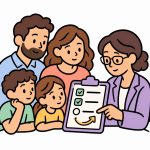
Family therapy progress review-3

3. Identify the Pattern, Not a Scapegoat

The focus is usually on recurring interactions. One person becomes frustrated, another withdraws, someone else tries to keep the peace, and the pattern repeats. Seeing the pattern more clearly gives the family something specific to work on.

Family problem-solving together-4

4. Build Practical Ways to Respond Differently

Family therapy is not only about talking through the past. Sessions may include communication strategies, problem-solving tools, parenting approaches or between-session tasks that help the family practise a different response in everyday life.

Family conversation circle-5

5. Review What Is Changing

As sessions continue, your therapist looks at what is improving, what is still difficult and where the approach needs to change. The goal is not a perfect family. It is a family that can handle difficult moments with more understanding, clearer communication and better tools.

Do All Family Members Need to Attend?

Not always.

Family therapy often involves several family members because problems that affect one person can affect the wider family as well. But that does not mean every person needs to attend every session.

Depending on the concern, sessions may involve the whole family, parents together, a parent and child, particular family members, or individual sessions within the wider family work.

If someone is reluctant to attend, that does not automatically mean nothing can change. Working with the family members who are ready to participate may still help shift communication and relationship patterns.

Family Counselling Brisbane Families Can Use for Practical Change

People use the terms family therapy and family counselling in slightly different ways, but the reason families seek support is usually the same: something is not working and the family needs a better way forward.

Thinking Families takes a practical approach. Sessions are designed to help you understand what is happening, make difficult conversations safer and develop strategies you can actually use outside the therapy room.

The work may draw on family therapy, cognitive behavioural approaches, mindfulness, schema therapy, solution-focused approaches and other evidence-based methods depending on who is attending and what the family needs.

The approach is not one-size-fits-all. A family dealing with a teenager’s behaviour needs something different from a family navigating grief, separation or a long-running communication breakdown.

Why Families Choose Thinking Families

Glenn Munt is an Accredited Mental Health Social Worker and Family Therapist who graduated from the University of Queensland in 1982. He has worked in private practice since 1988 and has extensive experience across adult, child and adolescent mental health, child protection, family therapy and individual therapy.

His previous roles include managing the family therapy unit at Lifeline Brisbane, working as Senior Social Worker and Family Therapist at the Royal Children’s Hospital Child and Family Therapy Unit, providing counselling through the Queensland Teachers Stress Management Centre, and supervising services including Kids Help Line and Parentline.

Glenn served as President of the Queensland Association of Family Therapy from 1995 to 1998 and has published in the Australian and New Zealand Journal of Family Therapy.

His private practice has focused on family and couple relationship counselling, separation and divorce, parenting, and child behaviour management.

For families, that experience matters because family problems rarely fit neatly into one box. What looks like a behaviour issue may also involve stress, relationships, school, parenting expectations or a major family change. Effective family therapy needs to make sense of the whole picture.

Our Counselling Services

Thinking Families provides a range of counselling services for Hamilton residents, with different options depending on who needs support and the concerns involved.

tf

Counselling for Eating Disorders

Eating disorders can be distressing and debilitating. As a parent it is common to feel powerless. Give your child the help they need.

tf

Family Therapy

Your family is your team, there to support you no matter what. Strengthen your bond and create loving, supportive teammates today.

tf

Child and Adolescence Counselling

Raising healthy kids isn’t without its unique challenges. We provide emotional and behavioural help when you need it.

tf

Counselling Services

Everyday problems have the ability to pile up and impact your quality of life. Counselling can help you overcome your obstacles and live a happier and healthier life.

tf

Counselling for Depression

In any single year, 1 million Australians will experience depression. Learn how to identify depression, and find ways to move forward to return the brightness to your life.

tf

Couples & Relationship Counselling

Are you feeling together but alone? Relationship counselling can help bring you and your partner back together, restore your passion.

tf

Anxiety Counselling

Anxiety can feel like you are carrying a great weight on your chest, or constantly struggling to breathe. Find your calm today.

Support for Parents, Children and Teenagers

Family problems often become most visible through a child or teenager, but that does not necessarily mean the young person is the only person who needs support.

A change in behaviour, increased conflict, withdrawal, anxiety, grief, school stress or difficulty adjusting after a separation can affect the whole household. Family therapy gives parents and young people a chance to understand what is happening around the issue, not just react to the latest argument.

Thinking Families also provides dedicated Child and Adolescent Counselling where more individual support is appropriate:

https://www.thinkingfamilies.com.au/child-and-adolescence-counselling/

For families supporting an adolescent with an eating disorder, Thinking Families also provides family-based treatment:

https://www.thinkingfamilies.com.au/eating-disorders-in-adolescence/

Family Therapy Through Separation, Divorce, Grief and Major Change

Some of the hardest periods for families are the ones where everybody is adapting at the same time.

Separation and divorce can change parenting roles, routines, communication and the way children understand their family. Grief can affect family members very differently. Illness, relocation and blended family changes can create new expectations before anyone has had time to adjust.

Family therapy provides a place to talk about those changes without expecting every family member to process them in the same way. The work can focus on reducing conflict, improving communication, clarifying roles and helping the family make decisions that are more workable for everyone involved.

Appointments, Fees and Rebates

Thinking Families is based at 87 Baroona Road, Paddington QLD 4064.

Appointments are generally one hour. Current clinic hours include weekday appointments and Saturday availability.

You do not need a referral to make an appointment. Medicare rebates may be available when you or your child have an eligible referral from a GP or specialist. Private health fund rebates may also be available depending on your fund and the service provided.

Because eligibility varies, check the current appointment, fee and rebate information before booking:

Family Therapy in Brisbane and Online

Thinking Families supports families from Paddington and across Brisbane, including people looking for counselling around Indooroopilly, Spring Hill, The Gap, Fortitude Valley, Clayfield, Ascot, Hamilton, Herston and Kelvin Grove.

Online family counselling is also available for Brisbane-based families who prefer to attend remotely.

If you are unsure whether family therapy is the right starting point, you do not need to work that out by yourself before getting in touch. Tell us what has been happening and we can discuss which type of support may be most appropriate.

Frequently Asked Questions​

How do I know if our family needs therapy?

Family therapy may be worth considering when the same conflicts keep repeating, communication has become difficult, family members are withdrawing from one another, or a major change is affecting how the household functions. You do not need to wait until the family is in crisis. If the problem is affecting relationships or everyday family life, it is reasonable to ask whether support could help.

The terms are often used interchangeably. Both focus on helping family members understand relationship patterns, communicate more effectively and respond to problems in more useful ways. The exact approach depends on the practitioner’s training and the needs of the family.

No. Family therapy may involve the whole family, specific family members or individual sessions within the broader work. Who attends depends on the concern, the goals of therapy and what is likely to be most useful.

The first session is usually about understanding what has brought the family in, how each person sees the problem, what has already been tried and what the family would like to change. The therapist may also explain how sessions work, confidentiality and what the next steps could look like.

You do not need a referral to book with Thinking Families. A Medicare rebate may be available for eligible services when you or your child have the correct referral from a GP or specialist. Eligibility depends on the service and your circumstances, so confirm the current rebate arrangements before booking.

Yes. Thinking Families provides online family counselling for Brisbane-based families who prefer to attend remotely.

Ready to Talk About What Is Happening in Your Family?

You do not need to arrive with the problem neatly explained or know exactly what type of therapy your family needs.

If family life has become stuck in the same arguments, distance or tension, the first step is simply to talk through what has been happening. Thinking Families can help you work out whether family therapy is the right approach and what the next step could look like.